
When a Woman No Longer Bleeds: Reclaiming the Wisdom Keeper Phase
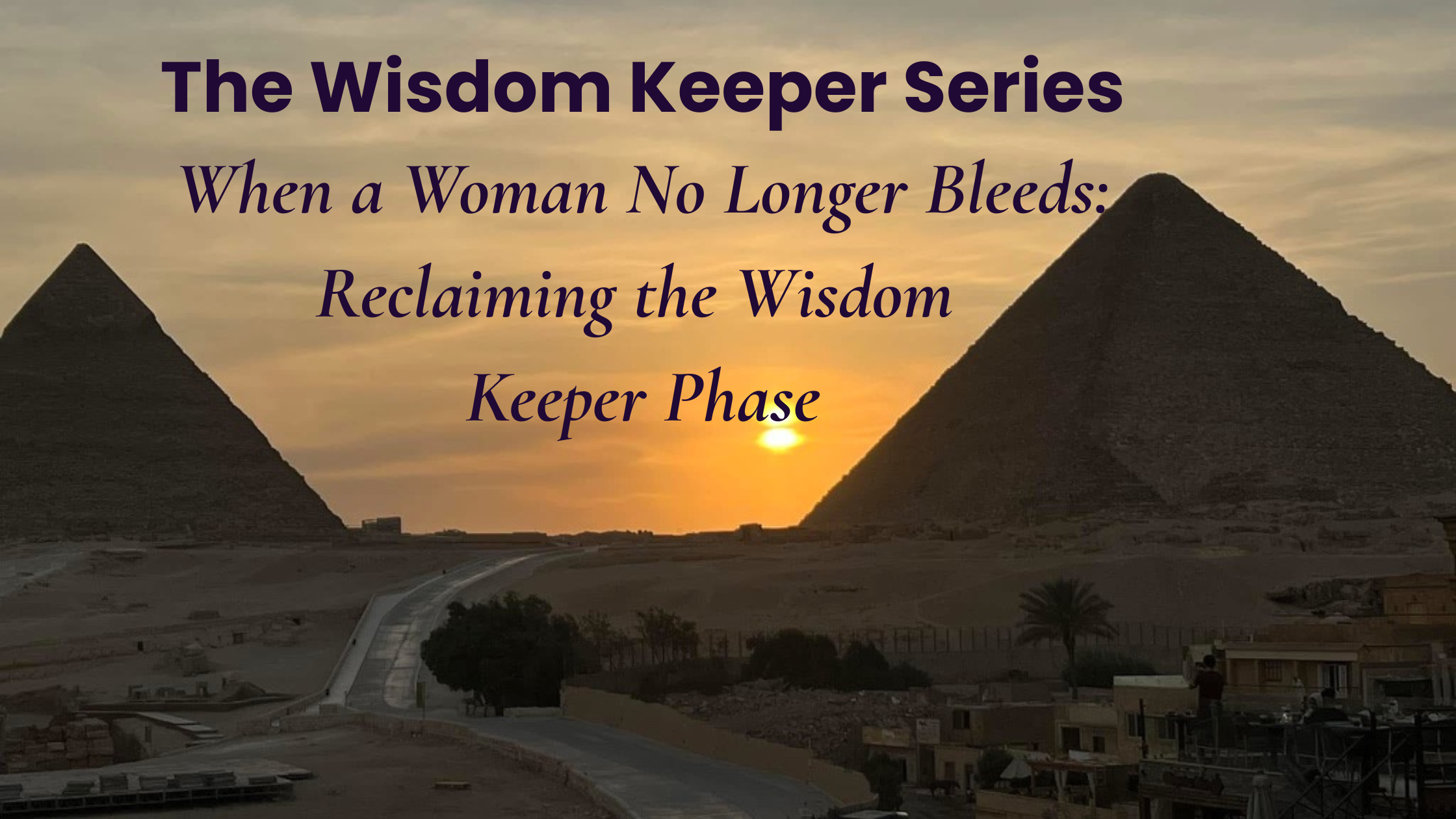
Ancient Wisdom for Modern Life
If you're lying awake at 3am wondering who you'll be once your body stops doing the thing it's done your whole adult life, or feeling a grief you can't quite name alongside the hot flashes and disrupted sleep - this is for you.
Menopause is rarely spoken about as anything other than a problem to manage. But across ancient cultures - from Egypt to Indigenous traditions to pre-Christian Europe - the years beyond bleeding were once understood as an initiation into a woman's most powerful season: the Wisdom Keeper phase. This is a look at what that ancient wisdom can offer the modern woman moving through menopause today.
Somewhere along the way, women were taught to fear this threshold.
To whisper about it.
To prepare for loss.
Loss of youth. Loss of fertility. Loss of relevance. Loss of beauty. Loss of being wanted.
We speak of menopause as something to endure, manage, survive, or get through.
And yet I find myself wondering;-
What if our ancestors understood something we have forgotten?
What if this season was never intended to represent decline?
What if it was always an initiation?
Across time and across cultures, there are traces of another story.
Not one that says women become more spiritual, wiser, or more valuable simply because they age.
But one that recognises that a woman who has lived, loved, created, grieved, endured, and changed carries something unique.
Perspective.
Discernment.
Pattern recognition.
Presence.
The ability to hold complexity without rushing to solve it.
This is not the end of womanhood.
This may be the beginning of the Wisdom Keeper phase.
Not every woman will relate to this language.
Not every culture described this season in the same way.
But perhaps there is something here worth remembering.
A Culture That Worships Blooming but Struggles with Ripening
Modern culture celebrates beginnings.
Newness. Growth. Potential.
But we speak less often about maturation.
We celebrate pregnancy more than menopause.
Firsts more than mastery.
Visibility more than depth.
And because of this, many women enter menopause carrying questions they never expected to ask.
Who am I if I am no longer needed in the same way?
Who am I if my body changes?
Who am I when I stop producing?
For many women, menopause arrives at exactly the same time as other thresholds.
Children becoming independent.
Parents ageing.
Careers changing.
Identity shifting.
The body asks for a different pace.
The soul asks for a different kind of attention.
And perhaps that is why this season can feel both disorienting and sacred.
Not because something is ending.
But because something is asking to emerge.
What Actually Happens in the Body
It's worth pausing here to acknowledge the physical reality plainly, rather than moving straight to metaphor.
Menopause is a real biological transition, marked by declining oestrogen and progesterone production as the ovaries gradually stop releasing eggs. It typically unfolds in stages - perimenopause, menopause itself, and postmenopause and the hormonal shifts can affect sleep, mood, temperature regulation, bone density, and far more.
None of the meaning-making in this piece is meant to replace good medical care. Hormone therapy, medical support, and proper monitoring matter, and any woman moving through this transition deserves real medical attention alongside whatever meaning she chooses to make of it. The two are not in conflict. A woman can take her hormones seriously and her initiation seriously, at the same time.
Ancient Wisdom and the Woman Beyond Bleeding
Many ancient traditions viewed life in seasons.
Different roles. Different responsibilities. Different forms of contribution.
Not better. Not worse. Different.
While there is enormous variation across cultures, a recurring thread appears:
The elder woman becomes less defined by reproduction and more connected to transmission.
Transmission of memory.
Transmission of values.
Transmission of wisdom.
She becomes not the centre of activity but often the keeper of continuity.
Ancient Egypt and the Wisdom of Continuity
My own fascination with ancient Egypt invites me here often.
There is no record of a formal menopausal rite in ancient Egypt - that's not a claim I want to make. But elder women in that world held real, documented standing: legal rights, household authority, ritual roles, and responsibility for what got passed down through a family line.
One concept I find myself returning to is Ma'at - truth, balance, right relationship, cosmic order.
It's not a teaching about menopause. It's older and bigger than that. But I find it a useful lens for this season anyway:
As we age, perhaps wisdom is not becoming more powerful.
Perhaps wisdom is becoming more aligned.
Less driven by urgency.
More guided by truth.
Not asking: What can I achieve?
But: What is worthy of my energy now?
This connects directly to the seven soul bodies framework - particularly the Ib, the heart, considered the seat of moral discernment in Egyptian thought. The menopausal transition often sharpens exactly this faculty.
Grandmother Wisdom Across Traditional Cultures
Many Indigenous and traditional communities recognised the importance of older women.
Not because they withdrew from life.
But because they became available to hold life differently.
There is real anthropological discussion about the role grandmothers play in human survival and community wellbeing - it's not just sentiment. Some researchers have proposed that the unusually long postmenopausal lifespan in human women, compared to most other mammals, may itself be an evolutionary adaptation, allowing grandmothers to support the survival of grandchildren. This is debated among scientists, but it's a striking reframe regardless: postmenopausal life isn't a biological afterthought. It may be a deliberate feature of how humans evolved to survive.
Spiritually, many traditions describe elder women as keepers of stories, holders of grief, guides through transition.
Not because they knew everything.
But because they had survived enough to recognise patterns.
The Crone Before the Word Became an Insult
In modern language, the word crone often carries distortion.
Yet in older European spiritual frameworks, the Crone represented something entirely different.
Winter. Truth. Discernment. Boundaries. Completion.
She was not disconnected from life.
She had simply stopped performing for approval.
There is something deeply liberating about that.
What Changes During the Wisdom Keeper Phase?
Perhaps not what we think.
This phase is not necessarily about becoming calmer. Kinder. More spiritual.
Life does not automatically grant wisdom.
Experience only becomes wisdom when we digest it.
But there are invitations available in this season.
An invitation to stop proving.
To stop performing.
To release obligations that were never truly ours.
To ask:
What do I actually want?
What matters now?
What am I no longer willing to bleed for?
I notice this often in women.
The beginning of softer boundaries and stronger truth.
Less rescuing. More witnessing.
Less urgency. More devotion.
Less self-abandonment. More self-respect.
Not becoming harder.
Becoming clearer.
The Gifts of the Wisdom Keeper
If I had to name the gifts that often emerge in this phase, they would be these:
Pattern recognition. You stop reacting to moments and begin recognising seasons.
Discernment. Not every opportunity deserves your energy.
Capacity for paradox. You can hold grief and gratitude at the same time.
Inner authority. You trust your own knowing more.
Presence. You become less interested in proving and more interested in living.
Blessing without controlling. You learn that love is not management.
Legacy. You begin thinking less about accumulation and more about transmission.
What do I leave?
What do I model?
What continues because I existed?
Ancient Wisdom Applied to Modern Life
Today, the Wisdom Keeper may not look like she once did.
She may not live in a village. She may not hold ceremony. She may not have grandchildren.
She may still be working. Starting businesses. Falling in love. Beginning again.
Perhaps today the Wisdom Keeper writes the book.
Starts the business at sixty.
Mentors younger women.
Rests without apology.
Speaks difficult truths gently.
Perhaps she stops asking: How do I stay relevant?
And begins asking: How do I stay connected?
Perhaps this season is not retirement from life.
Perhaps it is retirement from becoming who everyone else expected.
A Small Ritual for Crossing
If this season speaks to you, I invite you into a simple practice.
Light a candle.
Place one hand over your heart. One hand over your womb.
Take three breaths.
Ask yourself:
What am I no longer willing to bleed for?
What am I ready to preserve?
What wisdom wants expression through me now?
Then say:
“I honour all I have carried.
I release what no longer belongs to me.
I welcome the wisdom that is arriving.
I trust what is unfolding.”
Sit quietly. Listen.
You do not need to force an answer.
Frequently Asked Questions
Is menopause really an "initiation" in any historical sense, or is this just reframing? It's both, honestly. The biological transition itself isn't culturally constructed - it happens regardless of how any culture chooses to interpret it. But many traditions did choose to interpret this life stage as significant and transformative rather than purely as decline, and that interpretive choice is real and well documented, even where formal "initiation rites" specifically for menopause are not.
Does embracing this framework mean I shouldn't seek medical treatment for menopause symptoms? Not at all. Meaning-making and medical care aren't in competition. Many women find that addressing physical symptoms properly through medical support actually makes the deeper psychological and spiritual work of this season more accessible, not less.
What if I don't relate to the spiritual or mythic framing at all? That's completely fine. The practical shifts described here - clearer boundaries, less self-abandonment, more discernment about where your energy goes - are valuable regardless of whether you connect with the archetypal language used to describe them.
Where This Sits in the Series
This piece sits at the emotional centre of the Wisdom Keeper series. It builds on the seven soul bodies framework and the somatic understanding of how the body holds experience, and leads naturally into what this season grieves and the shadow side of the archetype worth being honest about.
Closing
Perhaps menopause was never designed to diminish us.
Perhaps it was designed to reveal us.
Not to make us disappear but to make us impossible to ignore.
Not because we become louder.
But because we become more true.
Perhaps this season is not the closing of a chapter.
Perhaps it is the moment a woman stops becoming who she thought she should be and begins becoming who she has always been.
And perhaps that is the deepest ancient wisdom of all.
Not that women lose power.
But that power changes shape.
If this season is asking something of you - if you're sensing the shift but can't yet name it, this is the territory I work in with women one-to-one and inside the Medical Intuitive Healing. Reach out (mariaheals.com) if you'd like support meeting this threshold consciously.